


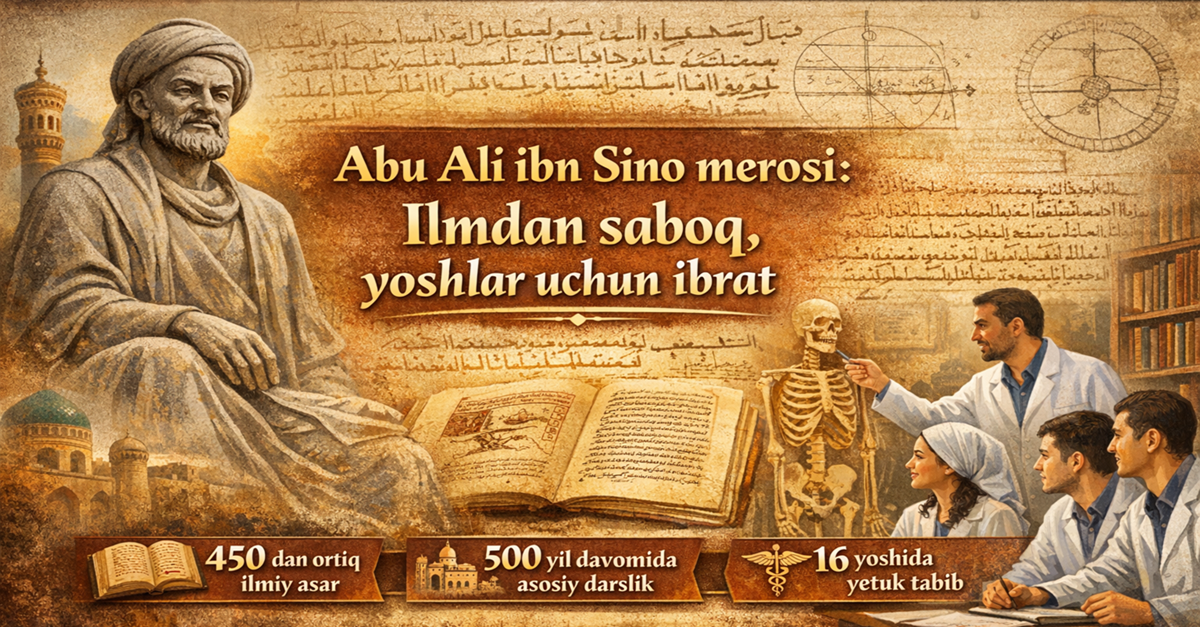
The Legacy of Abu Ali Ibn Sina as a Symbol of Scientific Awakening in the Minds of Youth
Abu Ali Ibn Sina, a great thinker who holds an exceptional place in the development of human intellect, is not only a prominent representative of the Eastern Renaissance but also one of the scholars who made a significant contribution to the advancement of world science. His scientific legacy has not lost its relevance over the centuries and continues to serve as a solid theoretical foundation for modern medicine and the education system.
According to sources, the scholar authored more than 450 scientific works, about 240 of which have survived to this day. In particular, his work “The Canon of Medicine” was taught as a primary textbook in European universities for nearly five centuries, which clearly demonstrates the high recognition of his scientific heritage. Notably, Ibn Sina was already recognized as a skilled physician at the age of 16 and actively engaged in medical practice. He conducted research in more than 29 fields of science, presenting a vivid example of a comprehensive approach to knowledge.
In his scientific views, special attention was paid to the causes of diseases, their prevention, hygiene, and proper nutrition—issues that remain highly relevant in modern medicine. Especially noteworthy is his approach based on clinical observation and experience, which is regarded as one of the fundamental pillars of modern medical methodology.
Today, for students studying in higher educational institutions, particularly in the field of medicine, the life and work of Ibn Sina represent not only a historical legacy but also a model guiding them toward scientific and spiritual development. His thirst for knowledge, perseverance in research, and recognition of human health as the highest value inspire a strong sense of responsibility in every student.
After all, today’s student is tomorrow’s physician. Therefore, the in-depth study of the invaluable scientific heritage left by our great ancestors, its integration with modern knowledge, and its practical application remain essential tasks for every young specialist.
In conclusion, the legacy of Abu Ali Ibn Sina is not only a pride of the past but also a solid scientific foundation for present and future development. Preserving and continuing this heritage is an honorable duty of every educated, dedicated, and patriotic young individual.